
EU AI Act Article 50(2): What the 2 December 2026 Marking Deadline Means for Your Generative AI
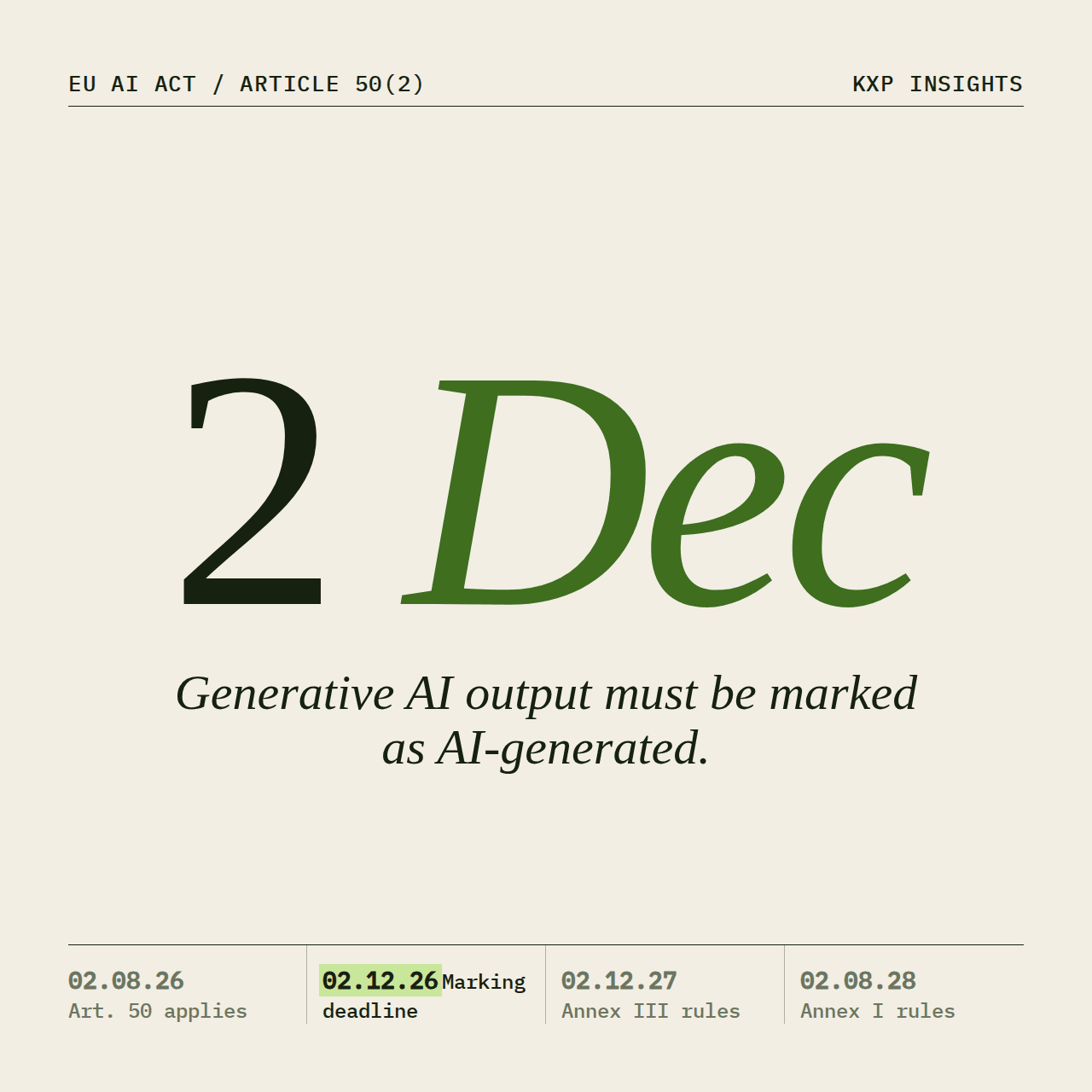
On 2 December 2026, a transition period in the EU AI Act comes to an end. From that date, generative AI systems that were already on the EU market before 2 August 2026 must mark what they produce as artificially generated, in a format machines can read.
For many organisations this is the first AI Act obligation that touches everyday tools rather than specialised high-risk systems. The assistant in the intranet, the chatbot on the website, the agent that drafts reports: if it generates content, it is worth checking whether it is in scope.
What Article 50(2) Requires
Article 50 of the AI Act sets out transparency obligations, and it has applied since 2 August 2026. Paragraph 2 is the one about generated content. It says that providers of AI systems, including general-purpose AI systems, that generate synthetic audio, image, video or text content shall ensure that the outputs of the AI system are marked in a machine-readable format and detectable as artificially generated or manipulated.
The law does not prescribe a single technique. It asks that the technical solutions be effective, interoperable, robust and reliable as far as technically feasible, taking into account the type of content, the cost of implementation and the generally acknowledged state of the art. In practice, that points to approaches such as watermarks, metadata and similar machine-readable signals.
Why the Deadline Is 2 December
The Digital Omnibus on AI, Regulation (EU) 2026/1744, amended the AI Act in July 2026. Among other changes, it added a targeted transition rule for systems that already existed: providers of generative AI systems placed on the market before 2 August 2026 shall take the necessary steps in order to comply with Article 50(2) by 2 December 2026.
Two consequences follow. Systems launched after 2 August 2026 never had a grace period; the marking obligation applied to them from day one. And for systems launched earlier, the grace period is now measured in days, not months.
The same Omnibus moved other dates further out. The core requirements for high-risk AI systems now apply from 2 December 2027 for systems listed in Annex III, and from 2 August 2028 for systems covered by Annex I. That makes the marking obligation one of the nearest AI Act milestones on the calendar.
Is Your System in Scope?
Three questions cover most of the ground.
- Does it generate content? The obligation concerns systems that generate synthetic audio, image, video or text. A summarising assistant, a document drafting agent or an image generator is a candidate. A system that only classifies, routes or searches is a different case.
- Does an exemption apply? The obligation does not apply to the extent the system performs an assistive function for standard editing, or does not substantially alter the input data provided by the deployer or its meaning. Spelling and formatting help is not the same as rewriting a document.
- Who is the provider? Article 50(2) places the duty on the provider of the system. If you use a vendor's product as it is, the vendor is likely the provider. If your team built the system, or substantially adapted one and put it into use under your own name, the duty may sit with you.
Not the Only Transparency Rule
Article 50 contains more than the marking duty. Providers of systems that interact directly with people must design them so that people are informed they are interacting with an AI system, unless that is obvious from the context. Deployers of systems that generate or manipulate image, audio or video content constituting a deep fake must disclose that the content has been artificially generated or manipulated. These rules have applied since 2 August 2026 and are worth reviewing in the same exercise.
Where to Start This Week
A short, practical sequence works for most organisations:
- Make an inventory. List every system that generates text, images, audio or video, including the ones that arrived quietly inside larger platforms.
- Mark the role. For each system, note whether you are the provider, the deployer or both, and when it was placed on the market.
- Check the output. For systems where you are the provider, confirm that outputs carry a machine-readable marking. For vendor systems, ask the vendor how they comply.
- Record the decision. Where you conclude an exemption applies, write down why. A short rationale today is easier than a reconstruction later.
None of this requires a large programme. It requires knowing which AI systems you run, what they produce and who is accountable for them, which is good governance with or without a deadline.
This article is a practical overview, not legal advice. For the binding text, see Regulation (EU) 2024/1689 as amended by Regulation (EU) 2026/1744 on EUR-Lex.
How KXP Can Help
KXP builds and runs AI systems for enterprises and public institutions, in the cloud and on-premise. If you want a clear picture of which of your generative AI systems are in scope, our AI team can start with an inventory and a short gap review. Get in touch.