
Why Isn't Your AI Scaling? The Answer Is in Your Data Governance

Some enterprises are still asking the same question in 2026: "Why isn't our AI project scaling?" The answer is often found in an unexpected place, not in the compute budget, not in the talent pipeline, but in data governance.
Deloitte's latest AI research paints a clear picture: the organizations that successfully scale AI are not necessarily the ones with the biggest models or the largest engineering teams. They are the ones that have built a disciplined, trustworthy data foundation beneath their AI ambitions.
The Hidden Bottleneck
Most enterprise AI projects begin with enthusiasm and end in frustration, not because the technology failed, but because the data wasn't ready. Models trained on inconsistent, siloed, or poorly labeled data deliver inconsistent, unreliable results. The AI delivers outputs that no business stakeholder can trust, and adoption stalls.
This isn't a model problem. It's a governance problem. And fixing it requires rethinking your data strategy from the ground up.
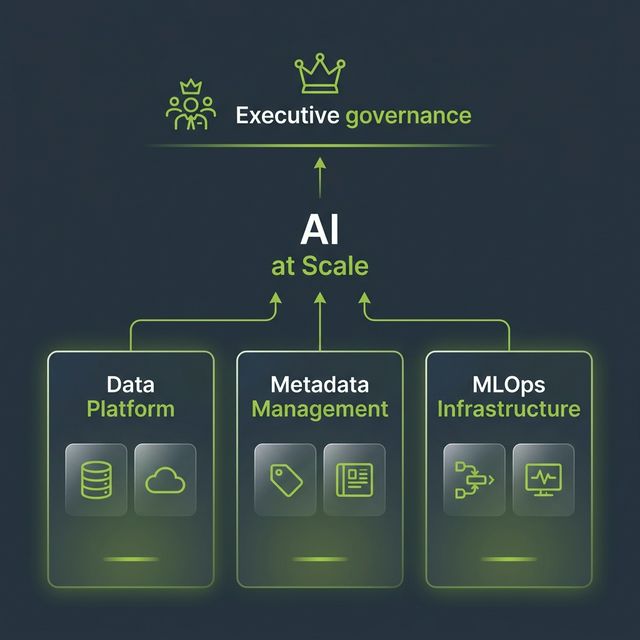
The Three Pillars of an AI-Ready Data Foundation
1. Data Platform Investment
The first pillar is architectural: building a data platform that unifies scattered data sources into a single source of truth. Many enterprises still operate with dozens of disconnected databases, data marts, and shadow IT systems, each with its own schema, its own data quality standards, and its own access controls.
A modern data platform consolidates these sources into a unified layer. This doesn't mean forcing all data into a single database, it means creating a coherent architecture where data from different sources is harmonized, deduplicated, and made consistently accessible to AI and analytics workloads.
Organizations that have made this investment report dramatically faster AI development cycles. When data scientists and ML engineers don't have to spend 70–80% of their time hunting for and cleaning data, they can focus on building models that actually solve business problems.
2. Metadata Management
The second pillar is often invisible but equally critical: metadata management. Metadata answers three essential questions about every piece of data in your organization:
- What is it?, A clear definition of what the data represents, in business terms, not just technical terms.
- Where does it come from?, A complete lineage record showing how data was created, transformed, and moved.
- How should it be used?, Data classification, sensitivity labels, and usage policies that govern who can access data and for what purposes.
Without robust metadata management, AI systems operate on data they don't truly understand. A model might inadvertently train on data that's out of date, from a deprecated source, or subject to regulatory restrictions. Metadata management is the layer that makes data trustworthy, not just available.
3. MLOps Infrastructure
The third pillar bridges data governance and AI operations: MLOps. A mature MLOps infrastructure automates the full lifecycle of AI model development, deployment, and monitoring, ensuring that the governance standards applied to raw data carry through to the models built on top of it.
This includes automated data validation pipelines that reject or flag data quality issues before they reach model training, model performance monitoring that detects drift and degradation over time, and complete audit trails that satisfy regulatory requirements.
MLOps is what transforms AI from a series of one-off experiments into a sustainable operational capability. Without it, organizations find themselves perpetually rebuilding models from scratch rather than improving them systematically.
The Leadership Dimension
Perhaps the most important finding from Deloitte's research is the role of senior leadership in AI governance outcomes. Enterprises where senior leaders actively shape AI governance, setting priorities, resolving cross-functional conflicts, and holding teams accountable to data standards, achieve significantly greater business value than those that delegate governance entirely to technical teams.
This makes intuitive sense. Data governance decisions are not purely technical. They involve trade-offs between data accessibility and privacy, between speed and quality, between short-term convenience and long-term trustworthiness. These are business decisions that require business leadership.
Organizations that treat AI governance as an IT function tend to end up with technically compliant but practically ignored frameworks. Organizations that treat it as a business function tend to build cultures where data quality is everyone's responsibility.
Governance Accelerates, It Doesn't Slow
A common misconception about data governance is that it creates bureaucracy and slows innovation. The evidence points in the opposite direction. When your data is well-governed:
- AI projects spend less time on data preparation and more time on model improvement.
- Business stakeholders can actually trust AI outputs, leading to genuine adoption rather than surface-level compliance.
- Regulatory audits become routine rather than emergencies.
- New AI use cases can be launched faster, because the data foundation is already in place.
Governance doesn't slow innovation, it creates the conditions for sustainable innovation at scale.
Is Your Data Strategy Ready for the AI Era?
If your organization is struggling to scale AI beyond proof-of-concept, the honest diagnosis usually reveals the same root cause: a data foundation that was designed for reporting, not for machine learning. Redesigning that foundation is not a simple task, but it is the necessary one.
At KXP, we help enterprises build the data platforms, metadata systems, and MLOps infrastructure needed to turn AI ambition into operational reality. The organizations that do this work now will compound their advantage for years to come.