
Agentic AI: How Autonomous AI Systems Are Transforming Enterprise Operations

The enterprise AI landscape is undergoing a fundamental shift. While the previous wave focused on chatbots and data analytics, a new paradigm, Agentic AI, is redefining what's possible. These autonomous systems go beyond answering questions; they plan, execute, and adapt in real time, transforming how organizations operate at every level.
From Copilots to Autonomous Agents
For the past few years, enterprises have embraced AI copilots that assist employees with tasks like drafting emails, summarizing documents, and generating reports. These tools added tremendous value, but they still required human initiation and oversight for every action.
Agentic AI takes this a step further. An agentic system can receive a high-level objective, such as "optimize our supply chain for Q2" or "resolve this customer's billing discrepancy", and autonomously break it down into subtasks, gather the needed data, interact with multiple enterprise systems, and deliver a completed outcome. The human role shifts from micromanaging tasks to setting goals and reviewing results.
Real-World Enterprise Applications
Organizations across industries are already deploying agentic AI to accelerate operations:
- Customer Service: AI agents that autonomously handle end-to-end support cases, from reading the ticket, checking order status across systems, to issuing refunds and sending follow-up emails, without any human intervention for routine cases.
- Finance & Accounting: Autonomous agents that reconcile invoices, flag anomalies, prepare journal entries, and generate compliance reports on a continuous basis rather than during month-end crunches.
- IT Operations: Agentic systems that detect infrastructure issues, diagnose root causes by querying multiple monitoring tools, apply standard remediation steps, and only escalate truly novel problems to human engineers.
- HR & Onboarding: AI agents that orchestrate the entire new-hire onboarding process, provisioning accounts, scheduling orientation sessions, distributing equipment requests, and following up on incomplete tasks.
The Architecture of Agentic Systems
What makes agentic AI fundamentally different from traditional automation is its architecture. These systems combine several capabilities that work in concert:
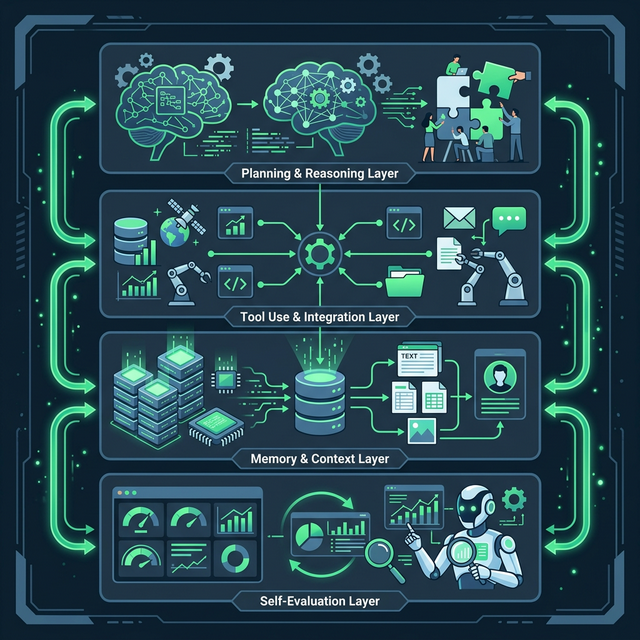
Planning and Reasoning: Agentic systems can decompose complex objectives into a sequence of steps, anticipate potential obstacles, and create contingency plans, much like a skilled project manager.
Tool Use and Integration: Rather than operating in isolation, these agents connect to enterprise APIs, databases, communication platforms, and external services. They act as intelligent orchestrators that can use dozens of different tools to accomplish their goals.
Memory and Context: Unlike stateless chatbots, agentic systems maintain rich context across interactions. They remember previous decisions, learn from outcomes, and build institutional knowledge over time.
Self-Evaluation: The most advanced agentic systems can evaluate the quality of their own work, identify when they're uncertain, and proactively seek human guidance when needed, creating a natural safety loop.
Building an AI-Ready Organization
Successfully adopting agentic AI requires more than just deploying new technology. Organizations need to prepare across several dimensions:
Data Foundation: Agentic systems are only as effective as the data they can access. Ensuring clean, well-structured, and accessible data across enterprise systems is the essential first step.
Process Mapping: Before an agent can automate a workflow, that workflow needs to be clearly understood and documented. Organizations that have invested in process optimization find it significantly easier to deploy agentic AI.
Governance and Trust: Autonomous systems need clear boundaries. Establishing governance frameworks that define what agents can and cannot do, setting approval thresholds for high-impact decisions, and maintaining comprehensive audit trails are essential for responsible deployment.
Change Enablement: As agents take on routine tasks, employee roles evolve. Investing in upskilling programs that help team members shift from task execution to strategic oversight creates a more engaged and effective workforce.
Measuring the Impact
Organizations that have adopted agentic AI report significant improvements across key metrics. Process cycle times often decrease by 60–80%, as agents work continuously without breaks or context-switching. Error rates in routine tasks drop dramatically due to consistent execution. Employee satisfaction typically increases as teams are freed from repetitive work to focus on higher-value activities.
Perhaps most importantly, agentic AI enables a level of operational scale that was previously impossible. A team of five, supported by well-designed AI agents, can achieve what previously required a team of twenty for routine operational tasks.
The Road Ahead
Agentic AI is not a distant future, it's happening now. The organizations that thrive will be those that start building the foundations today: investing in data infrastructure, mapping their processes, establishing governance frameworks, and nurturing a culture that embraces intelligent automation as a partner rather than a threat.
At KXP, we help enterprises navigate this transition with a structured approach, from identifying the highest-impact use cases to designing agent architectures that integrate seamlessly with existing systems. The question is no longer whether to adopt agentic AI, but how quickly you can begin.