
The AI-Powered Digital Workplace: What 2026 Looks Like for Enterprise Teams

The concept of a digital workplace has matured significantly since it first entered the enterprise lexicon. What started as email and shared file servers evolved into cloud-based collaboration suites, and then into the hybrid work platforms that defined the early 2020s. Now, in 2026, we're witnessing another leap: the emergence of the AI-powered digital workplace, an environment where artificial intelligence is not just a tool employees use, but an active participant in how work gets done.
The New Employee Experience
Today's digital workplace experience looks fundamentally different from even two years ago. Employees start their day with an AI-curated briefing that synthesizes messages, calendar priorities, project updates, and action items from across all their tools into a single coherent view.
Instead of spending the first hour of the day triaging emails and checking multiple platforms, team members receive a prioritized, context-rich summary that helps them focus immediately on what matters most.
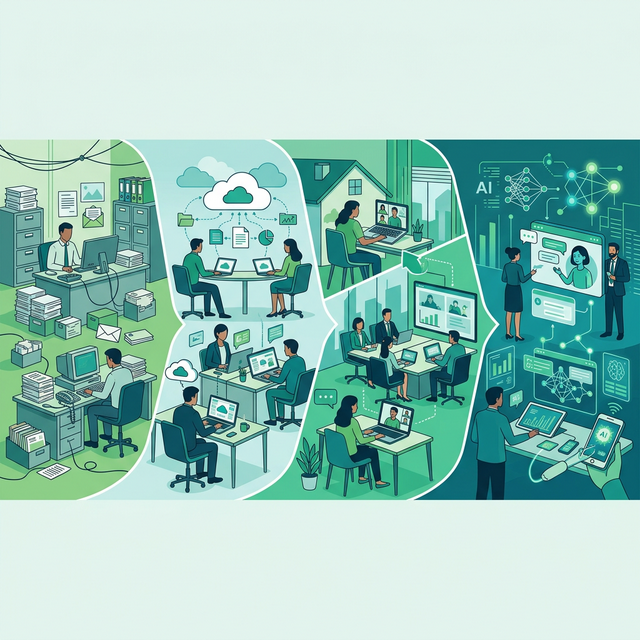
Throughout the day, AI copilots work alongside employees in real time. During document creation, they suggest content based on organizational knowledge bases and previous work. During meetings, they capture key decisions, assign action items, and draft follow-up communications. During data analysis, they surface patterns and generate visualizations that would have taken hours to create manually.
This is not about replacing human judgment, it's about amplifying human capability. Employees consistently report that AI-assisted workflows allow them to spend more time on creative, strategic, and interpersonal work while routine coordination and information gathering happen automatically.
Intelligent Collaboration at Scale
One of the most impactful developments in the 2026 digital workplace is how AI has transformed collaboration, particularly for distributed teams. Traditional challenges of remote and hybrid work, information silos, timezone friction, meeting fatigue, are being addressed through intelligent systems that adapt to how teams actually work.
Asynchronous-First Communication: AI tools now bridge the gap between real-time and asynchronous work far more effectively. Meeting recordings are automatically transcribed, summarized, and indexed so that team members in different timezones can catch up in minutes rather than watching hour-long recordings.
Knowledge Discovery: Enterprise search has been revolutionized. Instead of hunting through folders, channels, and wikis, employees can ask natural language questions and receive synthesized answers drawn from across the organization's entire knowledge base, complete with source attribution and confidence levels.
Adaptive Workflows: Digital workplace platforms now learn from team behavior to optimize processes. If a particular approval workflow consistently creates bottlenecks, the system suggests streamlined alternatives.
Security and Governance in the AI Era
As AI becomes more deeply embedded in workplace tools, organizations have developed mature approaches to security and governance:
Data Classification and Access: AI systems automatically classify content sensitivity levels and enforce access controls, ensuring that copilots and search tools only surface information that users are authorized to see.
Audit and Transparency: Every AI-assisted action is logged and auditable. Organizations can track what AI systems recommended, what actions were taken, and what data was accessed.
Human-in-the-Loop Controls: For sensitive operations, financial approvals, customer communications, policy changes, AI systems operate in an advisory capacity with mandatory human review.
The Cultural Dimension
Technology alone doesn't create a successful digital workplace. Organizations leading in this space have invested equally in cultural transformation. They've cultivated an environment where experimenting with AI tools is encouraged, where feedback loops between employees and IT teams are short, and where the goal of technology adoption is clearly tied to making people's work lives better.
Measuring Digital Workplace Maturity
- Integration Depth: How seamlessly do AI capabilities integrate across all workplace tools?
- Adoption Breadth: What percentage of the workforce actively uses AI-enhanced features daily?
- Time Recaptured: How many hours per week per employee are freed from routine tasks?
- Collaboration Effectiveness: How quickly can distributed teams align, make decisions, and execute?
- Knowledge Velocity: How fast does organizational knowledge flow from creation to the people who need it?
Organizations that score well across these dimensions consistently outperform their peers in employee satisfaction, operational efficiency, and innovation output.
Looking Forward
The AI-powered digital workplace is still early in its evolution, and the pace of improvement is accelerating. The organizations that build strong foundations now, investing in integration, governance, and culture, will be best positioned to adopt each new wave of capability as it emerges.
At KXP, we've been helping enterprises design and implement digital workplaces since the earliest days of this transformation. Our approach combines deep platform expertise with a human-centered methodology that ensures technology serves people, not the other way around.